A First 90 Days Master Class for Harvard Business Review Followers
Michael Watkins gave a live presentation to ca. 56K viewers on the Harvard Business Review Facebook Page as part of their Whiteboard Sessions Series. The 40-minute session was entitled, “How to Get Up to Speed in Your New Leadership Role” and focused on the following three key areas in the context of a new hire joining an organization from the outside:
- Why leaders fail or underperform when joining new companies.
- How to avoid common traps during the onboarding process.
- How to get up to speed in your new role much more quickly.
Drawing on the concepts and framework originally outlined in The First 90 Days, viewers were treated to a First 90 Days Master Class from the best-selling author, Co-Founder of Genesis, and Professor of Leadership and Organizational Change at the IMD Business School.
Following is a summary of the presentation with a link to the recording provided below.
Why capable leaders struggle when they join companies
More than a quarter of leaders in fortune 500 companies are transitioning into new roles in any given year and yet nobody seems to understand the dynamics involved in taking a new role, the traps that confound leaders as they onboard, and what they can do to get up to speed faster. Years of research and practical experience have led me to the conclusion that it is fundamentally about the learning process and the kinds of learning leaders need to do, but don’t do effectively—technical learning, cultural learning and political learning.
Technical learning is about getting up to speed with products, markets, technologies, systems of organization, etc. Few leaders fail for not having grasped the technical aspects of their new role.
It’s in the cultural and political learning domains—the subtle areas of the learning process—where problems arise. The subtle norms and values that inform the organizational culture are critical. Oftentimes, leaders are shocked to find that there is a different set of norms and values at a new organization and can be thrown by this.
In terms of political learning, consider that when you join a new organization you leave behind the networks, connections and relationships that made you effective in your previous role. The wiring—that set of equities and relationship bank accounts—is no longer there and needs to be built from scratch in the context of a new cultural environment.
The seven common traps to avoid
1) NOT CONNECTING EARLY ON WITH YOUR PEERS
The tendency to operate exclusively in the vertical relationships sphere—focusing energy on colleagues above and below—at the expense of the lateral. New leaders often underestimate the value of peer relationships and the role they play in helping you get things done. You don’t want to meet your neighbors in the middle of the night when your house is burning down, is an analogy that illustrates this common trap.
2) NOT UNDERSTANDING THE REAL RULES OF THE GAME
Understanding the subtle norms and values about how things get done in the organization is critical to your success. If you don’t pick up on these rapidly, you can bruise colleagues and get into downward relationship spirals.
3) SETTING UNREALISTIC EXPECTATIONS
Leaders often over promise and under deliver. Recruiting is like romance and employment is like marriage, so you need to make sure you don’t set unrealistic expectations at the outset.
4) THE ACTION IMPERATIVE
Starting a new role at a new organization is like drinking from a fire house, and one common trap leaders fall into is trying to do too much. We call it the action imperative and the reality of this trap is that you don’t focus, you over extend yourself, and you don’t achieve anything meaningful.
5) WHAT GOT ME HERE, WON’T GET ME THERE
The skills that made you successful at your previous job, will not ensure success in the new role. The tendency to stay in your comfort zone hinders your ability to adapt to the new challenges you face in the new organization.
6) COMING IN WITH THE ANSWER
Often leaders reach conclusions prematurely about what the organization needs. In so doing, they create an organizational immune system reaction. So being careful not to create the impression that you have the answer to problems people have grappled with for a long time is one of those subtle yet critical traps you need to be careful to avoid.
7) BEING “CAPTURED” BY THE WRONG PEOPLE
There is inevitably a jockeying that happens when a new leader joins an organization. The new leader needs to be studiously neutral with regard to the political structure of the organization until you are really clear about what alliances you need to build.
How to get up to speed more quickly in your new role

Our experience shows that having a common framework or roadmap —
implemented through coaching, blended programs and an eLearning operating system — can have a significant positive impact on your onboarding success. Time and again our research shows that time-to-performance rates can be halved and failure rates dramatically reduced, if you employ the right strategy and approach.
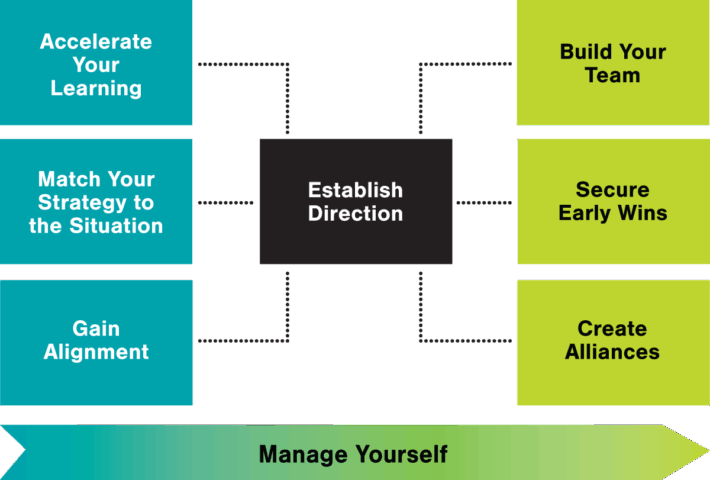
The First 90 Days® Transition Roadmap™ Framework
- Accelerate Your Learning – What can you do to speed up the learning process? Understand technical, cultural and political dimensions and what your focal point should be. Putting together a plan to speed up the learning process by being more structured in terms of how you engage with your new team.
- Match Strategy to the Situation – Transitions come in many sizes, shapes and flavors, so it is a mistake to apply the same approach to all transitions. Understand how to adjust your approach depending on different dimensions of the situation you face.
- Gain Alignment – Gain alignment with your boss(es) as you enter your new role. The single most important person/people in your transition typically are the people to whom you will be reporting. You need to align not just in terms of their expectations, but in terms of their understanding of the challenges you face. And perhaps most critically, you need to understand how they prefer to work with you.
- Establish Direction for Yourself and Your Organization – This means mission, goals, vision, strategies—the what, the how, the why. What are we going to accomplish, how are we going to do it, and why should we get excited about it. Getting increasingly clear on your direction, communicating your direction, and gaining alignment with your team about the direction are critical components of your onboarding success.
- Build Your Team – In most circumstances you inherit someone else’s team and need to assess, reshape, align and accelerate that team from the outset. You need to think about whether you have the right people in the right roles and how you align and organize the team to have the most impact as early on as possible.
- Securing Early Wins – Early wins are an indispensable part of the process because transitions are about momentum and the perception that you are taking the organization in a good direction. Understanding what early wins you are going to focus on, how you will get them, and how you will build support to make them happen, is crucial. (There is a component of this that is directly linked to the initial impression you make on joining the organization—your “entry posture” and the key messages you want to send as you onboard.)
- Create Alliances – In order to get things done, you need to create alliances. You don’t always have the authority to mandate that things happen. Often you are in a situation where you rely on key stakeholders, people who control resources you need access to, and the name of the game in order to get early wins and establish direction around them is to build key alliances. The ease and efficacy with which you do this is grounded in your understanding of the political structure of the organization, and of who is critical to make things happen, including how you build relationships and help others accomplish the things they want to accomplish.
Frequently Asked Questions
Q: What % of effort should you invest among the three dimensions — technical, cultural and political?
A: It very much depends on the level and the organization. For example, a manager may focus more on technical issues, whereas a more senior hire should focus more time on cultural and political dimensions.
Q: How do you set the correct timeframe when the new organization expects you to perform and have an impact in first 60-90 days?
A: Negotiate timeframes up front, and critically do not succumb to self-inflicted pressure to perform — an internal expectation to get things done. The time frames very much depend on your situation. For example, coming into a crisis is different from coming into a successful organization. In the case of the latter, you need only demonstrate that you are getting up to speed and fitting in with the organization, whereas the former requires a plan-and-execute approach. There’s not a “one-size-fits-all” answer.
Q: When you are new to a leadership role, is it better to work to make changes while you have new person momentum, or just focus on learning?
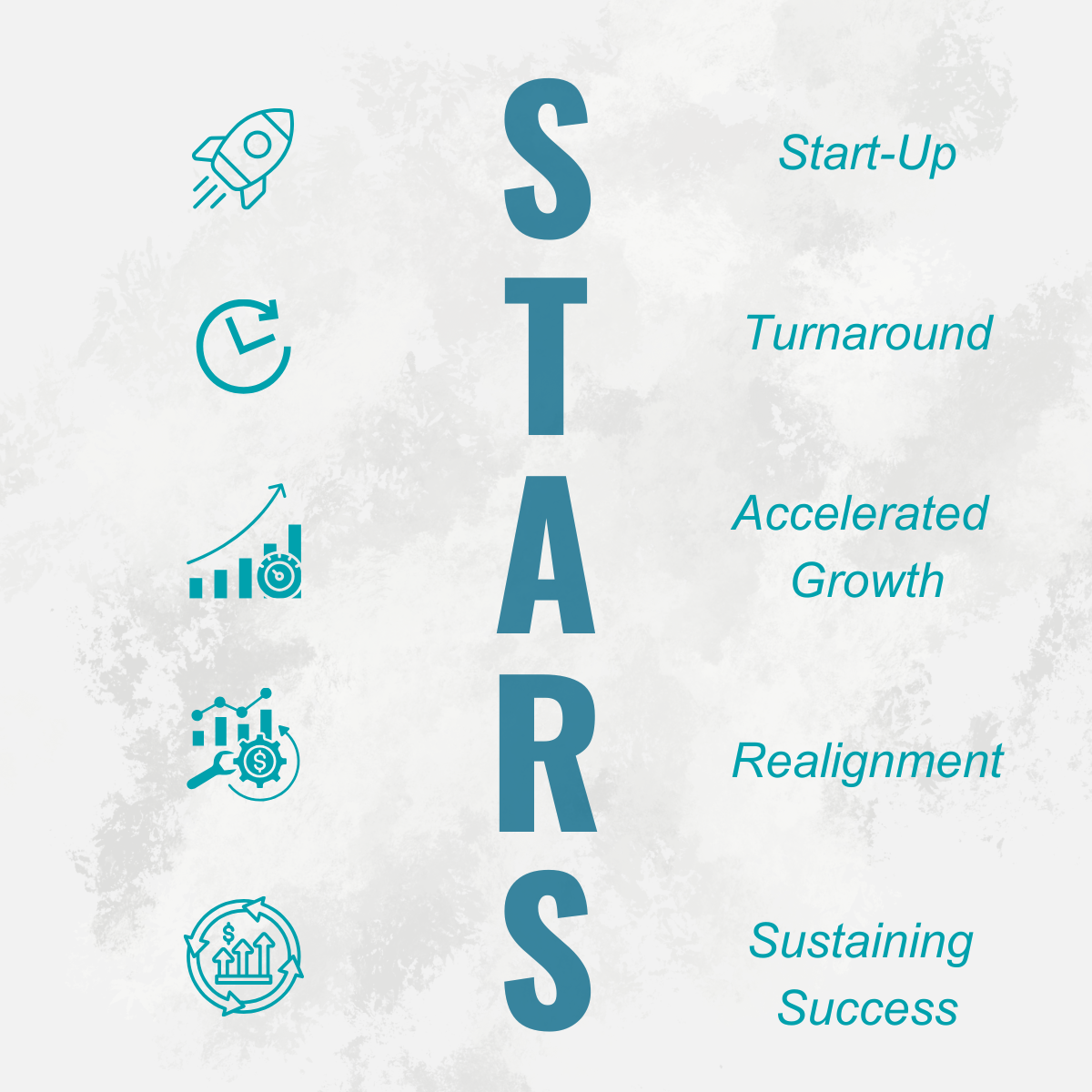
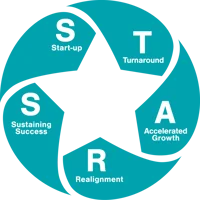
A: Again, it depends on the situation you are in (see our STARS Model). And once you have analyzed and identified the situation you are in, you can decide whether you need a plan-and-execute versus a learning and adapting modality.

Watch the recording of the entire live presentation.
We would like to express our sincere gratitude to the Harvard Business Review team for making this live Facebook presentation possible.