Moving Up to Enterprise Leadership: The Seven Seismic Shifts™

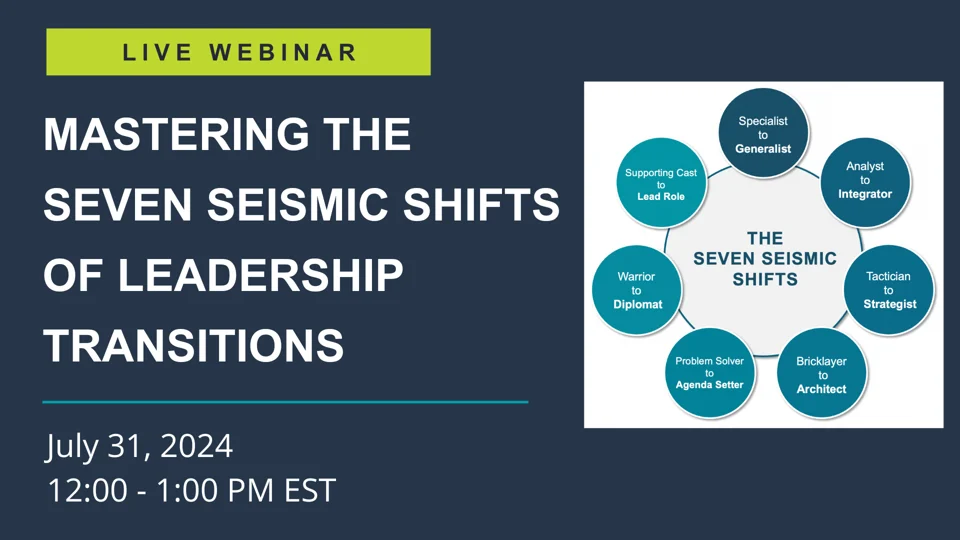
Based on my extensive interview research with newly appointed business unit leaders, senior executives charged with developing next-generation talent, and senior HR managers, I identified the seven seismic shifts that managers must make to become effective enterprise leaders:
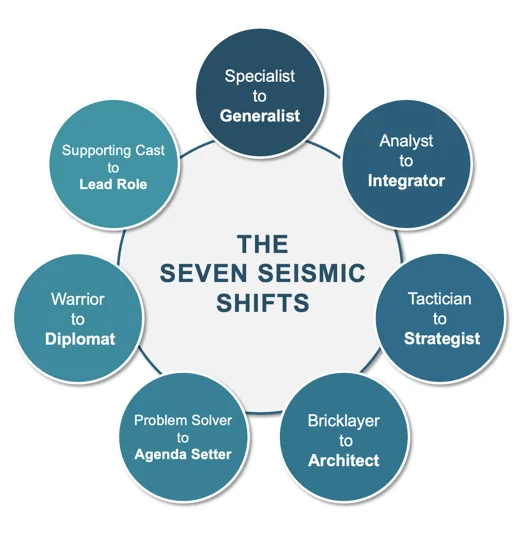
I’ve explored these shifts over the years, including in my popular HBR article “How Managers Become Leaders”. In the creation of our Leadership Development Journeys we utilize the Seven Seismic Shifts™ framework to help leaders navigate new challenges as they grow in their leadership experience.
1. From Specialist to Generalist
A company’s business functions are managerial subcultures with their own rules and languages. Therefore, managers transitioning to enterprise leadership roles must work hard to achieve “cross-functional fluency.” Someone who grew up in marketing obviously cannot become a “native speaker” of Operations or R&D. Still, you can become fluent—comfortable with the central terms, tools, and ideas employed by the various functions whose work they must integrate. Critically, enterprise leaders must know enough to evaluate and recruit the right people to lead functional areas where they are not experts.
2. From Analyst to Integrator
The primary responsibility of functional leaders is to develop and manage their people to achieve analytical depth in focused domains. By contrast, enterprise leaders manage cross-functional teams to integrate the collective knowledge and use it to solve critical organizational problems. Enterprise leaders must shift to managing integrative decision-making and problem-solving and, even more importantly, learn how to make appropriate trade-offs. Enterprise leaders must also work in the “white spaces”—accepting responsibility for issues that don’t fall neatly into any function but are still crucial to the business.
3. From Tactician to Strategist
More so than functional leaders, enterprise leaders establish and communicate strategic direction for their organizations. So, they must be able to define and communicate the mission and goals (what), the core capabilities (who), the strategy (how), and the vision (why) for their businesses. Additionally, they must be able to easily switch gears, seamlessly shifting between tactical focus (the trees) and strategic focus (the forest). Critically, they must learn to think strategically, which means honing their ability to (1) perceive essential patterns in complex environments, (2) crystallize and communicate those patterns to others in the organization in powerful ways, and (3) use these insights to anticipate and shape the reactions of other key “players,” including customers and competitors.
4. From Bricklayer to Architect
As managers move up in the hierarchy, they become increasingly responsible for laying the foundation for superior performance—creating the organizational context where business breakthroughs can happen. Enterprise leaders must understand how strategy, structure, systems, processes, and skill bases interact to be effective. They must also be experts in organizational design principles, business process improvement, and human capital management. Few high-potential leaders get formal training in organizational development theory and practice, leaving them ill-equipped to be the architects of their organizations or to be educated consumers of the work of organizational development consultants.
5. From Problem-solver to Agenda-setter
Many leaders are promoted on the strength of their problem-solving skills. However, when they reach the enterprise leader level, they must focus less on fixing problems and more on setting the agenda for what the organization should focus on doing. Being an agenda-setter means identifying and prioritizing emerging threats and communicating them in ways the organization can respond to. The rest of the task calls for mobilizing preventive action and driving organizational change. And it ultimately means creating a learning organization that responds effectively to shifts in its environment and can generate surprises for its competitors.
6. From Warrior to Diplomat
Effective enterprise leaders see the benefits in actively shaping the external environment and managing critical relationships with powerful outside constituencies, including governments, NGOs, the media, and investors. They identify opportunities for cross-company collaboration, reaching out to rivals to help shape the rules of the game. Functional managers, by contrast, tend to be more focused on developing and deploying internal capabilities to contend more effectively with key competitors.
7. From Supporting Cast to Lead Role
People in the business look to enterprise leaders for cues about the “right” behaviors and attitudes. At the functional leader level, it can be acceptable to be an efficient, effective manager, a member of the “supporting cast,” if you will. Enterprise leaders, by contrast, are constantly “on center stage,” being held to a higher standard—that of exemplary role models. For good or ill, the senior leadership of every organization is infectious; leaders’ behaviors tend to be transmitted to their direct reports, who pass them on to the next level and so on down through their organizations. Over time, they permeate the organization from top to bottom, influencing activity at all levels. Eventually, they become embodied in the organizational culture, influencing the types of people who get promoted and hired into the organization, creating a self-reinforcing feedback loop—either positive or negative.
Genesis Leadership Development Journeys help leaders develop critical management skills, such as:
- Influencing others to build credibility, foster relationships, and persuade stakeholders to support their vision.
- Navigating conflict, teaching leader strategies to manage and resolve disagreements constructively, maintaining a positive and productive work environment.
- Thinking strategically to help your leaders see the bigger picture, anticipate future challenges, and make informed decisions that align with your organization’s long-term goals.