Ten Key Elements of a Successful Transition
In this ten minute video interview Michael Watkins shares his formula for making successful leadership transitions with Suez (CREA), Europe’s second biggest water utility.
During the same visit with IBEX 35 organizations in Spain, Michael discussed how CEOs should approach a new role in a new organization in an interview with El Mundo entitled, “At First, the New CEO Must Listen” translated below. (Follow this link to read the full article in Spanish.)
Michael Watkins started his career at the Kennedy School of Government at Harvard University, where he was involved in the mediation of different international conflicts, like the one in Bosnia. His book The First 90 Days is the classic business reference for executives who assume leadership in organizations, both internal and external. He is a leadership transitions expert who coaches CEOs of Fortune 500 organizations and is professor of leadership and organizational change at the IMD Business School in Switzerland.
MS: What is the first decision you should take in a company as a newly-appointed CEO who comes from a sector other than company he or she is joining?
MW: Build the team correctly and understand the central problems that the organization has on the table. Although he will never know as much as the people who have been working for a long time in the sector, the new CEO will contribute a fresh perspective. The team will be key to creating a strategy. The CEO should look for a balance between industry knowledge, knowledge of the organization, and new approximations.
MS: Do you have to bring people from the team that you previously led?
MW: Depends on the severity of problem that exists in the company where he has been appointed. If the problem is serious, he can bring in people from outside. If the organization in which you have been appointed the new CEO is successful, it’s best not to bring in a lot of external people. Doing so could create an internal problem between the old guard and the new one. You have to know how to value internal talent. The key is to start giving messages about the value of the people who work in the organization.
MS: Do you have to send an email saying “here I am?”
MW: There is no reason to, though I agree it is good to announce your arrival. Does it have to be by email? Not necessarily. I recommend a message at the end the first week that indicates initial satisfaction on joining the organization.
MS: How should he conduct the first meetings?
MW: With the president of the Board and the Board of Directors, a lot of what happens in the first weeks are symbolic. The new CEO will not make decisions immediately and must send signals, for example, in the order of the initial meetings. It is important to visit the center of operations during the two first weeks, sending a positive message to the rest of the organization. Of course, you have to meet the first day with all the senior executive team. Give one welcome. You have to get together personally with each of the executives that are key in the company. These meetings should not be about intervention, but should be dedicated to listening. Follow a normal rhythm. Be as an observer — be attentive and proceed slowly. Unless, of course, there is a serious crisis that needs to be resolved.
MS: Who is the most important person on the executive committee?
MW: If it is a company that needs a big change, the financial director is in first place, followed by the director of operations. The HR director is key if it is necessary to reduce employee numbers. In a successful company with great vitality, the director of marketing is essential. The idea is to understand who your critics are and who you can trust.
MS: General Electric instituted an internal search for Jack Welch’s best successor. What predisposition exists today in USA between searching outside or inside of the company?
MW: Formerly, in most of the circumstances, there was an obvious successor within the company that was recognized over time. Nowadays, companies search internally and externally. It’s almost an obligation to do this.
MS: Does the external search also work for family businesses?
MW: There have been both cases. Looking for talent internally, because they are prepared for new scenarios and know that they have the necessary talent. However, in sectors such as pharmaceuticals, there is a need to look for new knowledge due to the constant innovation in the field. In any case, the key is to adapt your approach to the culture of the company, especially in the case of the family business. The external executive must learn with exceptional speed about the family and their traditions; learn how networks work within the company, which can be more complicated and informal than in a non-family business. On everything, you have to align yourself with the family.
MS: How do you balance these months of transition with personal life and not burn out?
MW: The initial weeks are essential. You do not want to exhaust yourself. I recommend to CEOs I coach to “disappear” for a few days before joining the new job. Once you are onboard, you will need to organize yourself and find a strategy that balances your time, establishing a methodical agenda that takes into account your work and your personal life. The biggest danger is losing the meaning of the objective, the connection with your family and friends, or neglecting your physical health. What happens in your personal life will impact your professional life.
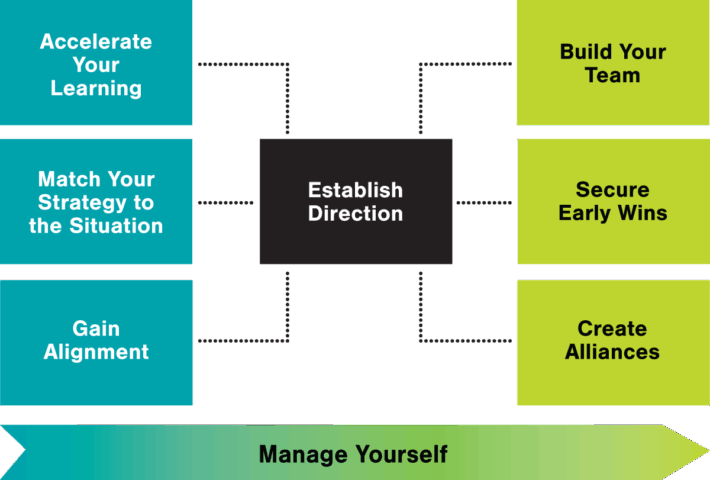
Ten Key Elements of a Successful Transition
- Mentally and physically prepare for the transition before it occurs; get fresh to the new position.
- Accelerate your learning and analyze which are the best sources of knowledge.
- Adapt your strategy to the situation of the company. Consider what each project, process and business unit requires; which business should be kept, which should be relegated, and which discarded.
- Negotiate success and establish the right relationships either with your boss, where the board of directors can be included, or with the leadership team.
- Ensure early victories to build trust and credibility.
- Identify the correct alignment of the company — structure, strategy, systems, capabilities and culture.
- Develop the team — either the one you’ve inherited or new team members. Establish new processes.
- Create alliances — determine the networks of influence inside and outside the company; the formal power compared with the informal.
- Manage yourself by routinely analyzing your emotional, professional and physical state. Estimate what is going well and badly, see how the professional transition affects the family circle and friendships, and rectify what is not going well.
- Accelerate everyone’s transition. Once you have identified the key elements of your decisions, involve your team with open communication and transparency. Know where you want to go and why.