The 7 Biggest Traps to Avoid in The First 90 Days
Posted by Michael Watkins
My research shows that leaders who derail or under-perform in their new roles often fall into common traps in their first ninety days. Have you fallen into any of these traps? Have you seen others do so?
Trap #1: Not adapting to the new culture
Leaders who move between companies (or even units of the same company) risk stumbling into cultural minefields. When new leaders act in ways that are inconsistent with the culture, they risk triggering an organizational immune system attack. The result is that they become increasingly disconnected and isolated from the flow of critical information about what is really going on in the organization. This further increases their vulnerability to making bad calls and contributes to a vicious cycle that ends in failure.
Trap #2: Not engaging in social learning
New leaders can become isolated because they spend too much time reading and thinking and not enough time meeting and talking. Sometimes this happens because the new leader wants to “know” the organization, by reading everything available, before venturing out into it. But the resulting isolation inhibits the development of important relationships and cultivation of sources of information about what is really going on. If this goes on for too long, the new leader may rapidly be labeled as remote and unapproachable. Impressions, ideas, and strong feelings about how to deal with issues are often more important than financial analyses in making crucial early decisions. New leaders must get out and into their organizations quickly.
Trap #3: Coming in with “the answer”
Another common trap is to come into the organization with “the answer,” a well-defined fix for the organizational problems. New leaders fall into this trap through arrogance or insecurity or because they believe they must appear decisive and establish a directive tone. But employees who perceive leaders to be dealing superficially with deep problems are inclined to become cynical, making it difficult to rally support for change. When employees believe their leader’s mind is made up they may become reticent to share information, which effectively impedes the leader’s learning about broader, more complex dimensions of the situation.
Trap #4: Staying too long with the existing team
New leaders, especially those with a collegial style, often believe that the subordinates they inherit deserve as much opportunity as possible to prove themselves. Some perceive this to be an issue of fairness; in others, it springs from arrogance (“I can make these people change better than my predecessor did”) or hubris (“All it takes is hard work, listening, giving them support, and just plain leadership”). Whatever the source of the impulse, retaining team members with a record of mediocre performance is seldom advisable. This is not to say that new leaders should be unfair, expect miracles, or fire people summarily. What they should do is impose a time limit—3-6 months is a good rule of thumb, depending on the severity of the problem—for deciding who should be on the playing field.
Trap #5: Attempting too much
Some new leaders try to do too many things at once, believing that “If I get enough things going, something is bound to click.” Such leaders are effectively trying to send a message that winners are active and quick and able to handle diverse challenges simultaneously. What this approach usually accomplishes, however, is to confuse and overwhelm people rather than spur them to action. New leaders have to experiment and try different approaches to discover what works and what doesn’t. But excessive experimentation can deprive promising change initiatives of the requisite critical mass of resources and attention.
Trap #6: Getting captured by the wrong people
The arrival of a new leader in an organization inevitably precipitates jockeying by those who have exerted influence in the old regime. Among the many people vying for a new leader’s attention will be those who (1) cannot help because they are not capable, (2) are well-meaning but out of touch, (3) actually wish to mislead, or (4) are simply seeking power for its own sake. New leaders must exercise care in deciding to whom to listen and to what degree. If selected internal advisors do not represent a broad enough constituency, have skewed or limited information, or use their proximity to the leader to advance partisan agendas, others might inadvertently be alienated and valuable input lost. Just as one is known by the company one keeps, so judgments about new leaders are based on perceptions of who influences them.
Trap #7: Setting unrealistic expectations
Finally, new leaders get into trouble when they assume that the mandate they negotiated before they entered the organization (or in the early days on the job) is the complete story, that it will remain unchanged or that it represents a blank check. New leaders should never presume that an initial mandate will or should remain unchanged. Rather, they must devote considerable effort during the transition to negotiating with their superiors to clarify their mandate and set expectations. Often, this means understanding the nature of key constituencies’ expectations and then carefully deflating those that are dangerously high, while taking advantage of those that can be useful.
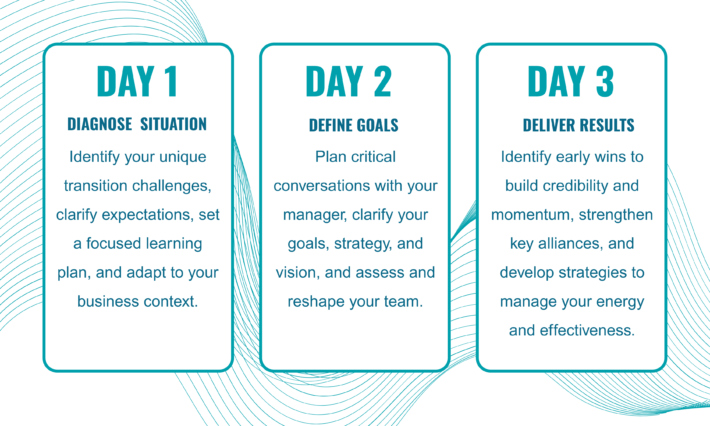
What does it take to avoid these traps? Self-awareness and a structured approach to learn, plan, and deliver during The First 90 Days.
Follow Michael Watkins on Twitter.