The Hidden Cost of Leadership Transitions in Pharmaceutical & Life Sciences

When a key leader exits or a new one steps in, the clock starts ticking. In the industry, every tick is expensive.
Leadership transitions are a fact of organizational life. But in the pharmaceutical and life sciences industry, they carry a weight that few other sectors can match. The pace of drug development, the complexity of regulatory environments, and the constant pressure of pipeline timelines. It all depends on strong, aligned leadership. When a transition falters, the ripple effects extend far beyond a single role.
Yet many organizations still treat leadership transitions as HR events rather than business-critical inflection points. The result? Significant cost, much of it hidden, and most of it preventable.
The Numbers Behind the Risk
The data on failed leadership transitions is stark across all industries. Our transition research has found:
-
40% of executive hires fail within 18 months. [1]
-
23% of leaders making internal moves fail to meet expectations in their first two years. [2]
-
The average cost of a failed transition is $2.7 million, and that figure doesn’t fully account for the downstream impact on teams, projects, and strategic momentum. [3]
In pharmaceutical and life sciences specifically, a leadership stumble in R&D, commercial, regulatory affairs, or medical affairs can delay product timelines, fracture cross-functional team dynamics, and erode the trust of key internal and external stakeholders, including clinical partners, commercial teams, and regulators.
These are not abstract risks. They translate directly into lost time, delayed launches, and stalled pipelines.
Why Pharmaceutical & Life Sciences Transitions Are Uniquely Complex
Leadership transitions in pharmaceutical industries carry a distinct set of challenges that make the typical “get up to speed” approach insufficient:
Highly matrixed, cross-functional environments
New leaders in life sciences often inherit complex webs of relationships across medical, clinical, regulatory, commercial, and market access functions that require careful and deliberate stakeholder mapping from day one. Missteps early can damage credibility with cross-functional partners who are essential to long-term success.
Regulatory and compliance sensitivity
Leaders who are new to the pharmaceutical context, whether promoted from within or brought in from another sector, must rapidly internalize regulatory frameworks, compliance expectations, and the culture of risk management that underpins every decision. Mis-calibrated judgment here isn’t just costly; it can be dangerous.
Global structure, local nuance
Many pharmaceutical organizations operate across multiple geographies with distinct market dynamics, cultural norms, and regulatory environments. Leaders transitioning into global or regional roles must balance enterprise strategy with local realities, a skill that demands both speed and nuance.
Pipeline pressure and board scrutiny
In publicly traded biopharma companies, new leadership can immediately affect analyst sentiment and investor confidence. New leaders need to establish credibility not just internally but externally, and quickly.
The Hidden Costs That Don’t Show Up on the Balance Sheet
The $2.7 million figure captures direct costs: severance, recruiting, onboarding, and lost productivity. But organizations rarely account for the full picture:
-
Team disengagement and attrition during a period of leadership uncertainty
-
Delayed decisions on critical projects while stakeholders wait for the new leader to “find their footing”
-
Loss of institutional knowledge when relationships with key external partners are disrupted
-
The reputational cost of a high-profile transition that goes sideways in a competitive talent market
-
Managerial bandwidth consumed by HR, the outgoing leader’s team, and the executive sponsor managing a fragile transition
In pharmaceutical and life sciences, where projects run on years-long timelines and key milestones are finite, the compounding effect of even a modest transition delay can reshape an entire product strategy.
What Effective Transition Support Actually Looks Like
The research is clear: structured transition support significantly accelerates time-to-performance and reduces the risk of failure. The question is whether organizations build it systematically or leave it to chance.
Based on the research of Michael Watkins, co-founder of Genesis Advisers and author of The First 90 Days, leaders who receive structured coaching and structured frameworks in the early weeks of a new role are significantly more likely to establish credibility, build momentum, and secure early wins that set the trajectory for long-term performance.
For pharmaceutical and life sciences organizations, this looks like:
-
Structured stakeholder mapping and early alignment conversations with cross-functional partners
-
A clear diagnostic of the situation type, whether the leader is stepping into a turnaround, a sustaining success, or a growth acceleration, and calibrating strategy accordingly
-
Early wins identification that builds credibility without overreaching before context is fully understood
-
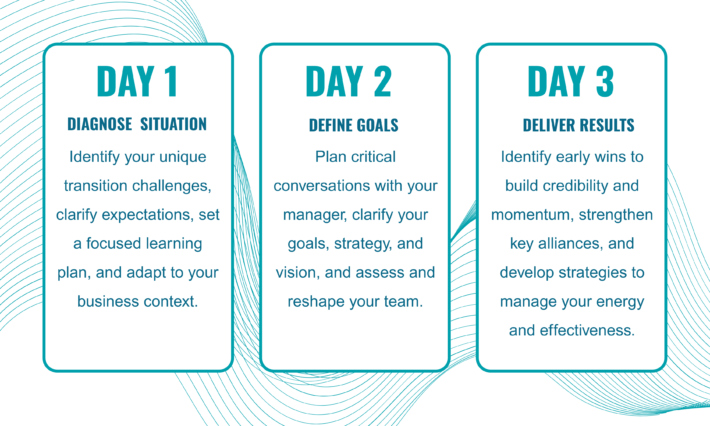
Coach-supported 90-day transition planning that integrates both organizational expectations and the leader’s development needs
-
Manager alignment and HRBP touchpoints to ensure organizational support isn’t just assumed, but actively cultivated
This is the philosophy behind Genesis Advisers’ Acceleration Coaching®, designed to halve the time it takes senior leaders to reach full performance, with a structured methodology built around the realities of high-stakes, complex organizational environments.
The Organizational Opportunity
Leadership transition support is one of the highest-return investments an organization can make, yet it remains one of the most underfunded and inconsistently applied. In pharmaceutical and life sciences, where the cost of leadership failure extends into pipeline performance, market competitiveness, and talent retention, the business case is not difficult to make.
The organizations that get this right don’t treat transitions as one-time events. They treat them as a core competency, building structured, scalable support into their leadership infrastructure at every level, from first-time managers stepping into cross-functional roles to newly appointed C-suite leaders navigating enterprise transformation.
The hidden cost of leadership transitions isn’t inevitable. With the right approach, it becomes an opportunity to build stronger leaders, more resilient teams, and organizations that move faster and with more precision in one of the world’s most demanding industries.
Ready to invest in your leaders’ transitions?
Genesis Advisers partners with pharmaceutical and life sciences organizations to accelerate leadership transitions and reduce the risk of failure. Our Acceleration Coaching® and First 90 Days® programs are built for the complexity your leaders navigate every day.
References
1 Watkins, M. (2013). The First 90 Days: Proven Strategies for Getting Up to Speed Faster and Smarter. Harvard Business Review Press. Data cited reflects research conducted with global organizations on executive transition outcomes.
2 Watkins, M. (2013). The First 90 Days. Harvard Business Review Press. Internal move failure data drawn from longitudinal research on leader transitions across Fortune 500 organizations.
3 Genesis Advisers internal research and analysis based on client engagements and publicly available transition cost modeling. See also: Ciampa, D., & Watkins, M. (1999). Right from the Start: Taking Charge in a New Leadership Role. Harvard Business School Press.

Genesis is a global provider of leadership development programs, coaching, and transition acceleration solutions for individuals, teams, and organizations. Genesis offerings are based on the research of Michael Watkins, co-founder and author of the book "The First 90 Days." Genesis provides a comprehensive range of programs, coaching processes, and consulting services aimed at speeding up transitions at all levels, from front-line managers to C-level executives.