Why Most Leadership Transitions Fail—and How to Succeed
Leadership transitions are deceptively hard.
On the surface, stepping into a new role often looks like a logical next step—more responsibility, broader scope, greater influence. Organizations assume that because someone has succeeded before, they’ll succeed again.
And yet, research and experience consistently show that a significant percentage of leadership transitions underperform or fail outright.
Not because leaders lack talent or motivation—but because transitions fundamentally change the rules of the game.
The Real Reasons Leadership Transitions Fail
Most transitions fail for predictable reasons. Unfortunately, they’re also reasons that are easy to overlook in the rush to “hit the ground running.”
1. Leaders underestimate how different the new role really is
Success in a prior role creates confidence—but also blind spots. New roles often require different ways of thinking, influencing, and prioritizing. What worked before may not work now, yet many leaders default to familiar habits too quickly.
2. They move too fast before diagnosing the situation
The pressure to deliver early results is intense. As a result, leaders take action before they truly understand the business context, the team dynamics, or the expectations of key stakeholders. Speed replaces sense-making—and missteps follow.
3. Expectations are unclear or misaligned
Critical conversations with managers and stakeholders are often delayed or handled superficially. Leaders assume alignment instead of explicitly creating it, only to discover later that success was defined differently by different people.
4. Teams are inherited, not intentionally reshaped
New leaders frequently accept existing team structures by default. Without assessing capabilities, roles, and dynamics early, they miss the chance to build a team aligned with their goals and strategy.
5. Early wins aren’t planned
Credibility doesn’t come automatically with a title. Leaders who don’t deliberately plan early wins struggle to build momentum and trust, making everything else harder.
6. Energy is depleted, not managed
Transitions are cognitively and emotionally demanding. Leaders focus on outcomes but neglect their own sustainability—leading to burnout, poor judgment, and diminished effectiveness.
What Successful Transitions Do Differently
Leaders who succeed in transitions don’t necessarily work harder. They work more deliberately.
They recognize that the first 90 days are not about proving competence as quickly as possible—but about setting a foundation that allows competence to show up consistently over time.
Successful leaders:
- Slow down early to diagnose their situation before acting
- Clarify expectations through intentional, structured conversations
- Define what success looks like in this role, not the last one
- Assess and reshape their teams instead of inheriting them passively
- Identify early wins that matter to the organization
- Build alliances that support execution and learning
- Manage their energy as carefully as their strategy
In short, they design their transition rather than improvising it.
Why the First 90 Days Matter So Much
The early period of a transition creates patterns—of communication, decision-making, trust, and credibility—that are surprisingly hard to undo later.
Misalignment compounds. Early mistakes linger. Missed opportunities to build relationships and momentum are difficult to recover.
Conversely, when leaders approach this period with clarity and structure, they accelerate learning, reduce risk, and increase the odds of long-term success.
Designing a Strong Transition
Over the years, my work with leaders across industries has made one thing clear: transitions improve dramatically when leaders are given space, structure, and support to think through their situation before acting.
That insight is the foundation of the First 90 Days® Express Open Enrollment
This three-day immersive experience is designed for leaders across The Americas who are stepping into a new role—either within their current organization or at a new company—and want to approach that transition with intention.
Across three days, participants focus on:
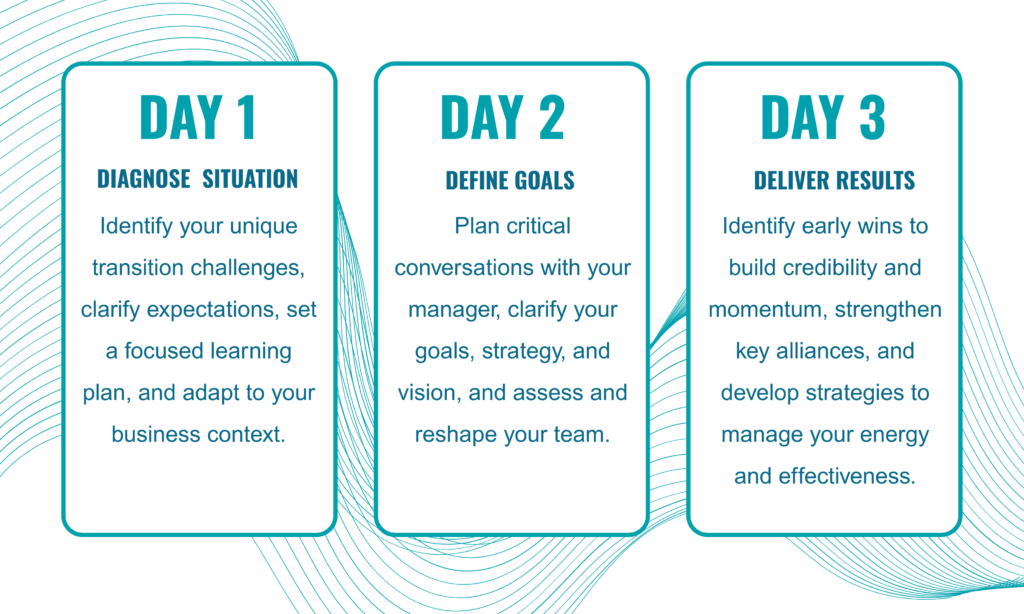
The program blends plenary sessions, facilitated peer learning, and 1:1 coaching to ensure insights are applied directly to each participant’s real transition—not treated as abstract theory.
A Better Way to Begin
Leadership transitions will always involve uncertainty. That’s unavoidable.
Failure, however, is not.
When leaders take the time to design their first 90 days—rather than reacting to them—they dramatically increase their chances of success.
If you’re approaching a transition and want to learn more about how to apply this approach, please visit First 90 Days® Express. Applications for the April 14–16, 2026 cohort are now open, with early bird pricing available through February 15.

Michael Watkins has spent the past two decades working with leaders, both corporate and public, as they transition to new roles, negotiate the future of their organizations, and craft their legacy as leaders. A recognized expert in his field, he ranked among Thinkers50’s top fifty management influencers globally in 2019. He is the best-selling author of The First 90 Days, Updated and Expanded: Proven Strategies for Getting Up to Speed Faster and Smarter, the globally acknowledged handbook for leadership and career transitions, which recently earned the accolade of Amazon’s Top 100 Leadership Books. He is Professor of Leadership and Organizational Change at the IMD Business School in Switzerland and previously served on the faculty at INSEAD and Harvard University, where he earned his PhD in Decision Sciences.